
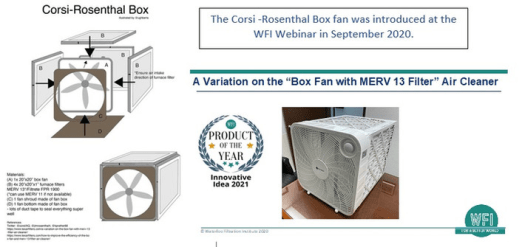
Indoor air quality has shown itself to be one of the most effective tools we have to fight COVID-19 transmission. Many K-12 schools, technical schools, colleges and universities have followed the guidance of aerosol scientists and air quality experts by installing portable HEPA air filters or Corsi-Rosenthal (CR) Boxes to increase air exchange.
Portable air filters can serve as an augmentation to HVAC systems, so there is a great benefit to adding portable air cleaners even for buildings that have already been able to improve ventilation systems. Even when HVAC systems have been upgraded with MERV-13 filters, many do not achieve an eACH of at least 6, and therefore require supplementation via portable HEPA air filters or CR Boxes.
CR boxes are a do-it-yourself alternative to portable HEPA air filters that have been proven safe and effective at a fraction of the cost. In March 2022, the White House issued a Clean Air in Buildings Challenge, “a call to action for organizational leaders and building owners and operators of all types to assess their indoor air quality and make ventilation, air filtration, and air cleaning improvements to help keep building occupants safe. As part of the challenge, the Environmental Protection Agency (EPA) published a best practices guide for improving indoor air quality and reducing the risk of spreading dangerous airborne particles”, which includes an endorsement of Corsi-Rosenthal boxes (reference links included below under EPA and White House headings). A single CR box has the ability to increase the eACH of a classroom by an additional 4 to 7 eACH (or more).
Cleaner air has benefits beyond COVID-19, including reducing spread of other viruses and bacterial illness, fewer allergens, fewer asthma exacerbations, and improved test scores. Cleaner air also means less dust, allergens, mold spores, lead dust, and asbestos fibers, which unfortunately continue to be discovered in our aging school buildings.
Funding is available. The U.S. Department of Education’s Elementary and Secondary Schools Emergency Relief (ESSER) Programs and the Department of Health and Humans Services’ Head Start and Child Care American Rescue Plan support improvements to ventilation; repairs, upgrades, and replacements in HVAC systems; purchase of MERV-13 air filters, portable air cleaners, and upper-room ultraviolet germicidal irradiation systems (UVGI).
CO2 monitoring:
CO2 monitoring is an important tool for assessing the adequacy of ventilation. The CDC and aerosol experts indicate that CO2 concentrations below 800 parts per million (ppm) is a recommended target.
 CNEPS
CNEPS 